
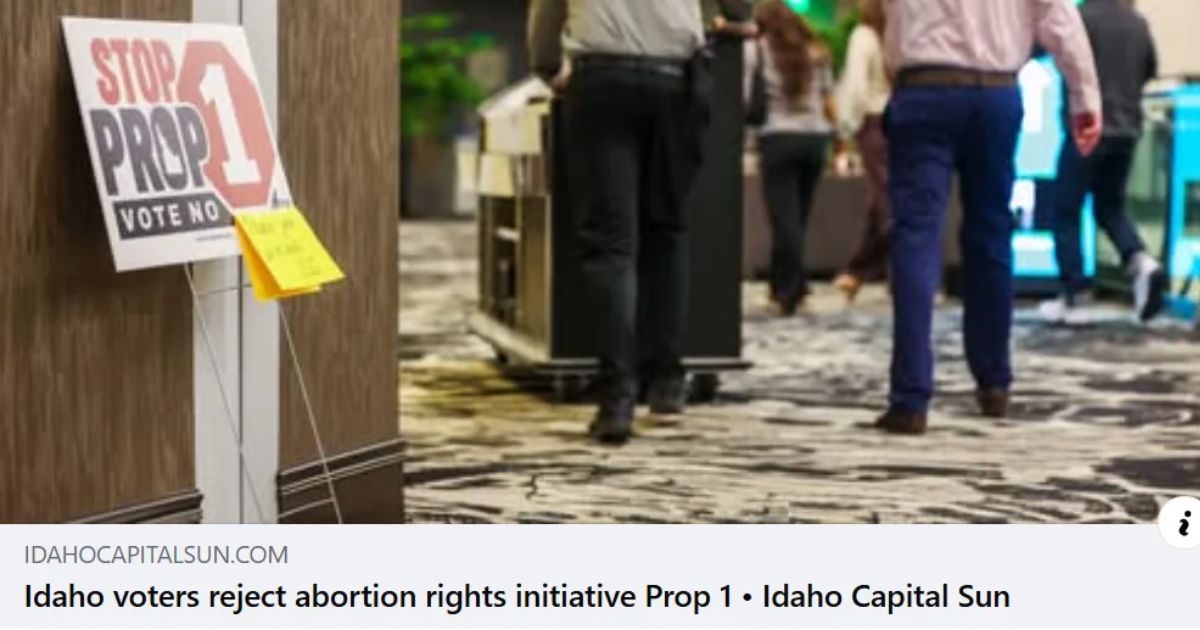
Now that we’ve had a few weeks to digest the victory over Proposition 1, it’s worth reviewing some of the important lessons we should take away from that win.
First, the victory was far too close. In a deep-red state like Idaho, the margin was only 55.91% to 44.09%.
Proposition 1 wasn’t some moderate abortion initiative. It was a much more radical measure that would have moved Idaho’s abortion laws significantly closer to those of states like California and New York.
The fact that it was defeated by less than 12 percentage points should concern every conservative in this state. To me, that suggests we were fortunate the initiative was as extreme as it was. Had it been a more moderate proposal, there’s a very real chance it would have passed.
Second, both The Church of Jesus Christ of Latter-day Saints and the Catholic Church played major roles in the victory. They mobilized their members, and their financial contributions, approximately $1 million from the LDS Church and $300,000 from the Catholic Church, helped fuel an advertising campaign that was necessary to counter the messaging coming from the Yes on 1 side.
At the same time, we cannot downplay the role that evangelical churches across Idaho played in defeating Proposition 1.
What stood out most to me was the level of unity among conservative organizations and churches. I have not seen cooperation like this in a very long time, perhaps ever, on an issue of this magnitude. I personally had conversations with people I do not normally agree with politically or religiously, yet we were all working together and strategizing on how to stop Proposition 1.
Had Proposition 1 been a more moderate initiative, I suspect we would have seen far more division within the coalition than we ultimately did.
That leads me to my biggest concern.
The political left continues to target Idaho, and one of its primary methods is the ballot initiative process.
They know many of these ideas would be dead on arrival if introduced through the Legislature. But through ballot initiatives, they can spend enormous amounts of money, simplify complex issues into emotionally charged campaign slogans, and benefit from a media environment that is often sympathetic to their goals.
Thankfully, Idaho voters have rejected these efforts in the last two election cycles. But conservatives should not assume future victories are guaranteed.
The reality is that defeating a clearly radical initiative is one thing. Defeating a carefully crafted, better-funded, and more moderate proposal is something entirely different.
As of today, there is still no permanent statewide apparatus ready to respond to these battles. The coalition that defeated Proposition 1 was assembled largely out of necessity. It came together because the threat was obvious.
The question is whether that same coalition will still be prepared when the next initiative is less extreme, more polished, and far more difficult to defeat.
If conservatives want to keep winning these fights, they cannot wait until the next ballot initiative appears. They need to build the infrastructure, relationships, and messaging now. Because the next battle may not be as easy to identify, and it almost certainly won’t be easier to win.
Note: Thumbnail image from Pat Sutphin from Idaho Captial Sun.
Leave a Reply